

Solid oak is one of the most prized materials for furniture and flooring, but it can exhibit variations such as cracks and warping. Understanding the reasons for these issues is essential to maximizing the durability and beauty of the wood in your home. In this article, we will examine the main factors that contribute to the cracking and warping of solid oak.
The moisture content of wood
Hygrometry is the measurement of the humidity level in the air or within a material.
Different moisture levels according to usage
| Green wood | Wood for outdoor use | Wood for interior woodwork |
| 35 to 120% | < 19% | 9 to 13% |
Impact of air humidity and temperature on wood
What are the impacts of humidity levels on wood?
Shrinkage and swelling are the dimensional changes in wood that occur based on its moisture content, and therefore, the amount of water present in its cells.
The dimensions of the wood will then vary: by losing moisture, the wood will contract (shrinkage), whereas by absorbing moisture, it will expand (swelling).
Wood is a living material
Wood is a so-called living material; despite being processed "dry," it will continue to move throughout its life.
Humidity levels in a home and impact on the life of wood
The humidity level in a home is generally between 30% and 70%.
Despite the fact that the indoor temperature is stable, the humidity of the air changes, and so does that of the wood.
Examples at an indoor temperature of 20°C: If the humidity level is 30%, the wood's moisture content would drop to 7%. Conversely, if the humidity level is 70%, that of the wood can rise to approximately 13%, see diagram below:
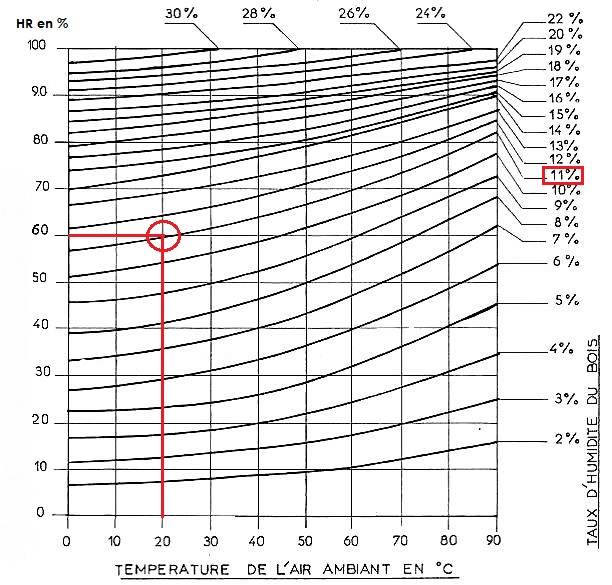
Source: https://www.expert-bois.fr/a-quelle-humidite-le-bois-se-stabilise-t-il
Adaptation to its new environment
Wood stability
When wood is machined "dry" and stored properly, it does not warp in its machining location because the environment is stable.
Impact of changing environment on wood
When it arrives in a new environment, a sudden change in temperature and humidity can cause the panel to cup, especially if it is not stored properly. The wood should be stored horizontally, and air must be able to circulate above and below it.
Other factors, such as exposure to sunlight (a tabletop behind a large window, for example), can create a hygrometric shock on only one of the two sides, leading to cupping and/or cracks.
Characteristics of wood
Beyond moisture content, several fundamental elements of wood can lead to cracks and warping:
- The wood species;
- The size of the wood planks used;
- The thickness of the wood used (a thickness of 10 mm will crack less than a thickness of 40 mm, but will be more sensitive to cupping);
- Panel assembly (it is recommended to alternate grain directions to limit tension);
- The parts of the wood used (central parts are more prone to warping and cracking);
- Rest periods between the different stages of assembly and production (it is essential to allow enough time for tensions to be released).
Conclusion:
We use solid wood, characterized by wide and thick planks, which creates greater tension compared to materials like finger-jointed wood or thin wood strips. If you would like to know more, click here to access our article.
It is essential to recognize that wood is subject to movement throughout its life. This characteristic must be taken into account when designing projects, particularly by choosing appropriate fastening hardware and assembly techniques.
At Brut de Table, we pay special attention to slow and controlled drying, which is essential to minimize this risk and ensure the stability of the wood. Our customer service is also fully available to answer your requests, in the event that your tabletop moves once in your home.
By understanding these factors and realizing that wood remains a living material subject to changes throughout its life, you will be better prepared to understand the normal aging process of your furniture.